
For many, the idea of eating raw fish can be intimidating. At the heart of that hesitation is a simple question: “How do I know this is actually fresh?” In the world of Japanese cuisine, “fresh” isn’t just a marketing term—it’s a disciplined standard of safety and flavor. Today, we’re going beyond the surface to teach you how to evaluate sushi like a true connoisseur.
The “Flash-Frozen” Secret: Why It’s Better Than Fresh
It sounds counterintuitive, but “fresh off the boat” isn’t actually the gold standard for sushi. To be served safely as “Sushi-Grade,” fish must undergo a process called Super-Freezing (or Flash-Freezing).
By dropping temperatures to -40°F or lower immediately after the catch, the cellular structure of the fish is preserved perfectly. This process does two critical things: it eliminates any potential parasites and locks in the natural oils and umami. When you eat at a high-end restaurant like Kiyama Sushi, you are eating fish that has been handled with this pharmaceutical-grade precision.
The Visual Inspection: Color and Clarity
Your eyes are your best defense. Before you take a bite, look for these specific indicators of quality across different varieties:
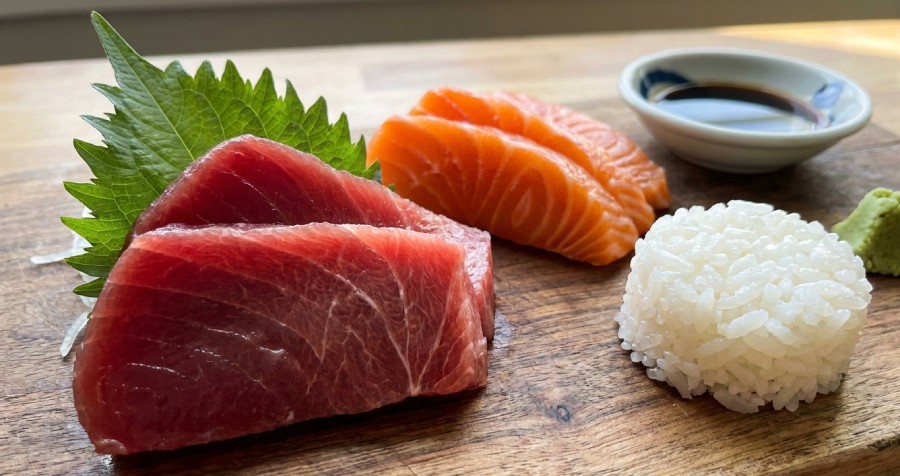
- Tuna (Maguro): It should have a deep, translucent clarity. If the tuna looks “matte” or has a brownish hue, it has likely been exposed to oxygen for too long.
- Salmon (Sake): Look for bright, vibrant orange flesh with clean white fat lines (marbling). It should look moist, but never “sweaty” or oily on the surface.
- Whitefish (Hamachi/Tai): These should be nearly translucent. If the meat looks opaque or “milky,” it may not be at its peak freshness.
The “Scent” of a Masterful Sushi Bar
A common misconception is that a sushi restaurant should smell like fish. In fact, the opposite is true. High-quality raw seafood has almost no scent at all, or perhaps a very faint, clean aroma of the ocean. If you walk into a restaurant and are hit with a heavy “fishy” smell, it’s a sign that the seafood is oxidizing. A great sushi bar should smell of clean wood, cooling rice, and perhaps a hint of fresh cucumber.
The Soul of the Dish: The Rice (Shari)
While the fish gets the spotlight, sushi is defined by its rice. In Japan, a chef may spend five years learning just how to cook the rice correctly. High-quality Shari should be:
- Intact: Each grain should be visible and distinct, not mashed into a paste.
- Seasoned: It should have a balanced tang from premium rice vinegar, a hint of salt, and a touch of sweetness.
- Temperature: Traditional sushi rice is served at body temperature. Cold, hard rice is a sign of sushi that has been sitting in a refrigerator—a major red flag for quality.
The Chef’s Skill: Knife Craftsmanship
Finally, look at the cuts. High-quality sashimi is cut with a single, fluid motion using a Yanagiba (willow leaf blade). This leaves the surface of the fish perfectly smooth. If the edges of your fish look “ragged” or “torn,” it means the knives were dull or the technique was rushed, which actually changes the way the fish feels on your palate.
📍 Experience the Kiyama Standard
At Kiyama Sushi, we take pride in our rigorous sourcing and traditional preparation. We believe that transparency is the key to a great meal. Next time you visit us in Lake Stevens, feel free to ask our chefs about today’s catch!
Kiyama Sushi
📍 8011 20th St SE, Lake Stevens, WA 98258
📞 Phone: (425) 610-4379
📧 Email: contact@sushikiyama.com